In shortPena Palace history starts with a 12th-century chapel on the hilltop. Manuel I built over it in 1503, handing the new Monastery of Our Lady of Pena to the Order of Saint Jerome. Earthquake damage and the dissolution of the religious orders in 1834 left a ruin, which Ferdinand II bought with his own funds in 1838 and rebuilt from 1842, with the clock tower finished in 1843.
1503Monastery ordered by Manuel I
1838Ferdinand II buys the ruin
1843Clock tower finished
1995UNESCO World Heritage listing
Pena Palace history in dates
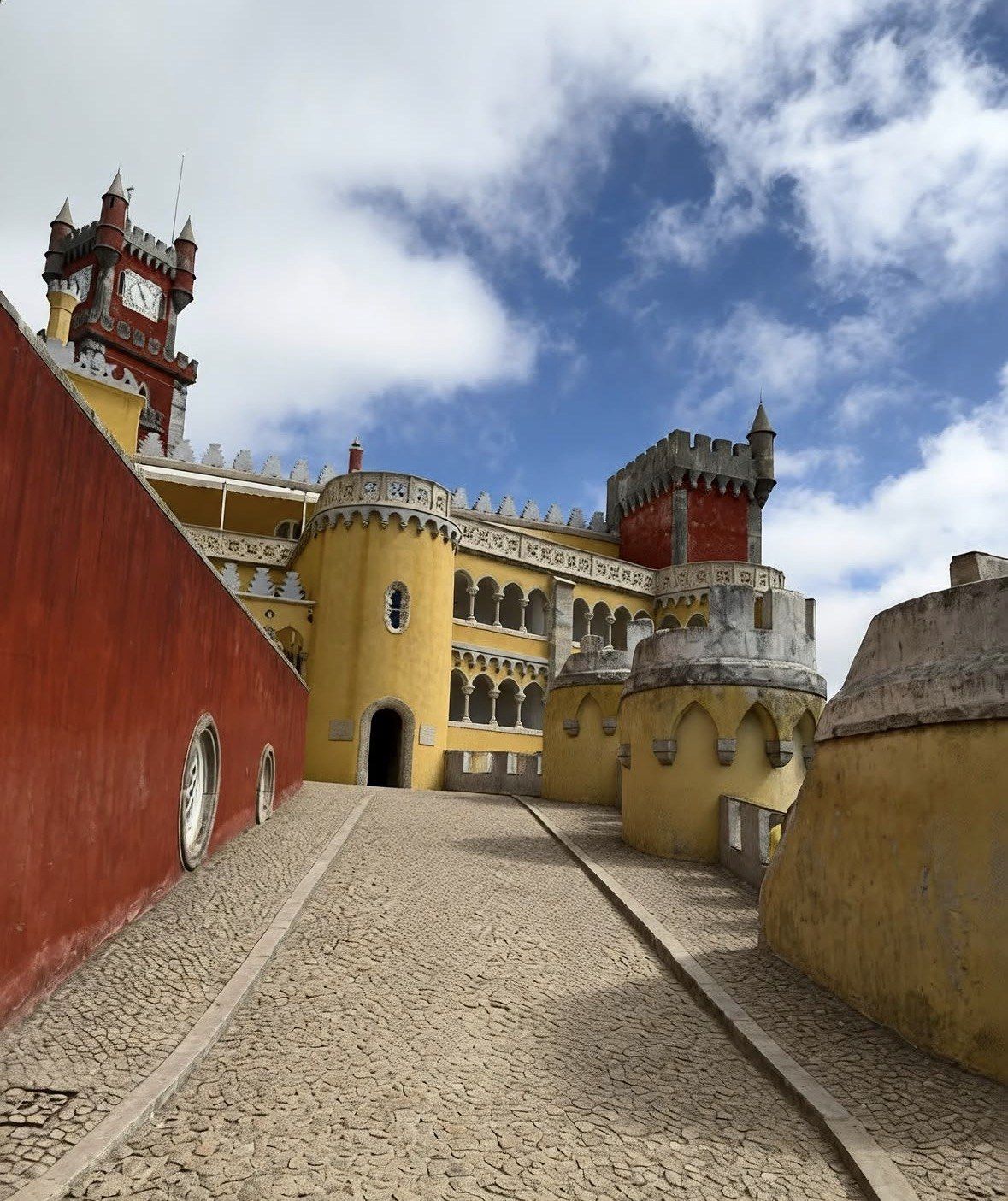
Most of the confusion on the visitor route comes down to one thing. Pena is two buildings joined together, a Manueline monastery and a 19th-century palace wing, and both sit inside a third layer of mock patrol paths, merlons, battlements, watch-towers and a tunnel that leads to a drawbridge. Work out which of the two you are standing in and the order of the rooms starts to make sense.
The dates below come from Parques de Sintra, and where its history page says nothing, from the record of the construction campaign. The managers give 1910 as the classification year while other published sources give 10 January 1907; the table follows the official history page.
| Date | What happened |
|---|
| 12th century | A chapel already stands on the hilltop that the palace later covers |
|---|
| 1503 | Manuel I orders the Monastery of Our Lady of Pena, entrusted to the Order of Saint Jerome |
|---|
| 1511 | The Manueline Cloister is built, with galleries round a square patio |
|---|
| 1529–1532 | Nicolas de Chanterenne carves the main altar retable for João III |
|---|
| 1834 | The religious orders are dissolved and the monastery is left empty |
|---|
| 1838 | Ferdinand II buys the ruin and the land around it with his own funds |
|---|
| 1842–1854 | The palace is built, with the clock tower completed in 1843 |
|---|
| 1869 | Ferdinand II marries Elise Hensler, who takes the title Countess of Edla |
|---|
| 1889 | The Portuguese State buys the palace |
|---|
| 1910 | Pena is classified a National Monument |
|---|
| 1995 | UNESCO inscribes the Cultural Landscape of Sintra as World Heritage |
|---|
The monastery Manuel I ordered in 1503
The hilltop was in religious use long before anyone thought of a summer residence. A chapel had stood there since the 12th century, and in 1503 Manuel I ordered a monastery on the same ground, the Monastery of Our Lady of Pena, entrusted to the Order of Saint Jerome. The northern half of the building is still the oldest part you walk into.
Two pieces of it are worth stopping for. The cloister went up in 1511, round arches on the lower floor and segmental arches above, and the walls of its patio are covered in Hispano-Mudejar tiles in the cuerda seca technique. Then the chapel, which began life as the Monastery Church of Our Lady of Pena before being reworked into the palace: João III commissioned its main altar retable, cut in Sintra alabaster and limestone by Nicolas de Chanterenne between 1529 and 1532.
The monks used the cloister entrance until 1834, the year the religious orders were dissolved. Earthquake damage and years of neglect did the rest, so what stood on the ridge four years later was a shell. The interior page on this site runs through the rooms in visiting order if you want to know what is coming before you book a slot.
The dates explained in the rooms they belong to
Five hours from €80, a guide beside you and the Pena Palace Essential Ticket for the interior and the park already included, which is what you want when the cloister and the chapel are the reason you came.
★ 4.9/5 · 624 reviews
Who bought the ruin and who ran the works
Ferdinand II, known as the King-Artist, bought the ruined monastery and the surrounding land in 1838 and paid for it out of his own funds rather than the treasury. Building work ran from 1842 to 1854. The clock tower was finished in 1843, the same year the New Palace wing began to rise beside the old monastic core.
Supervision of the project went to Baron Wilhelm Ludwig von Eschwege, a mineralogist and mining engineer with no training in architecture. That shows in the result: a building put together from quotations, each part borrowing from somewhere else, with the German Romantic castles of Stolzenfels, Rheinstein and Babelsberg among the references. The architecture page on this site goes facade by facade.
In the monastery half, Ferdinand II had the upper floor reworked so that 14 monks' cells became a smaller number of larger vaulted rooms, and he added a double staircase of parallel flights at the cloister entrance. Opposite the chapel's main altar he set a stained-glass window of 1840, made by the Kellner family workshop in Nuremberg. The planting started at the same time, with Asian camellia collections going into the park through the 1840s.
Elise Hensler and the chalet on the western slope
Elise Hensler was born in Switzerland in 1836 and sang opera before she married Ferdinand II in 1869 and received the title Countess of Edla. On the western side of the park the two of them built a two-storey house in alpine style as a place of leisure, designed by the Countess herself, and she kept the use of the chalet and its garden until 1904.
Fire destroyed it in 1999. Parques de Sintra rebuilt it over about four years and reopened it to the public in 2011, and in 2013 the work received the Europa Nostra European Union Award for Cultural Heritage in the Conservation category. What you see today includes the Family Dining Room, the Kitchen, the Staircase Atrium, the Ivy Room, the Dining Room, the Bedroom, the King's Toilette, the Countess of Edla's Toilette and the Wardrobe, along with the garden and the Chalet Stones.
The chalet sits inside the park and palace admission, so nothing separate is needed for it. It stands well away from the palace, out in the western reaches of the park, and opens 09:00 to 17:30 with the last admission at 17:00. If the chalet is the part of the story you came for, go before mid-afternoon; the chalet page has the detail.
How Pena became state property and World Heritage
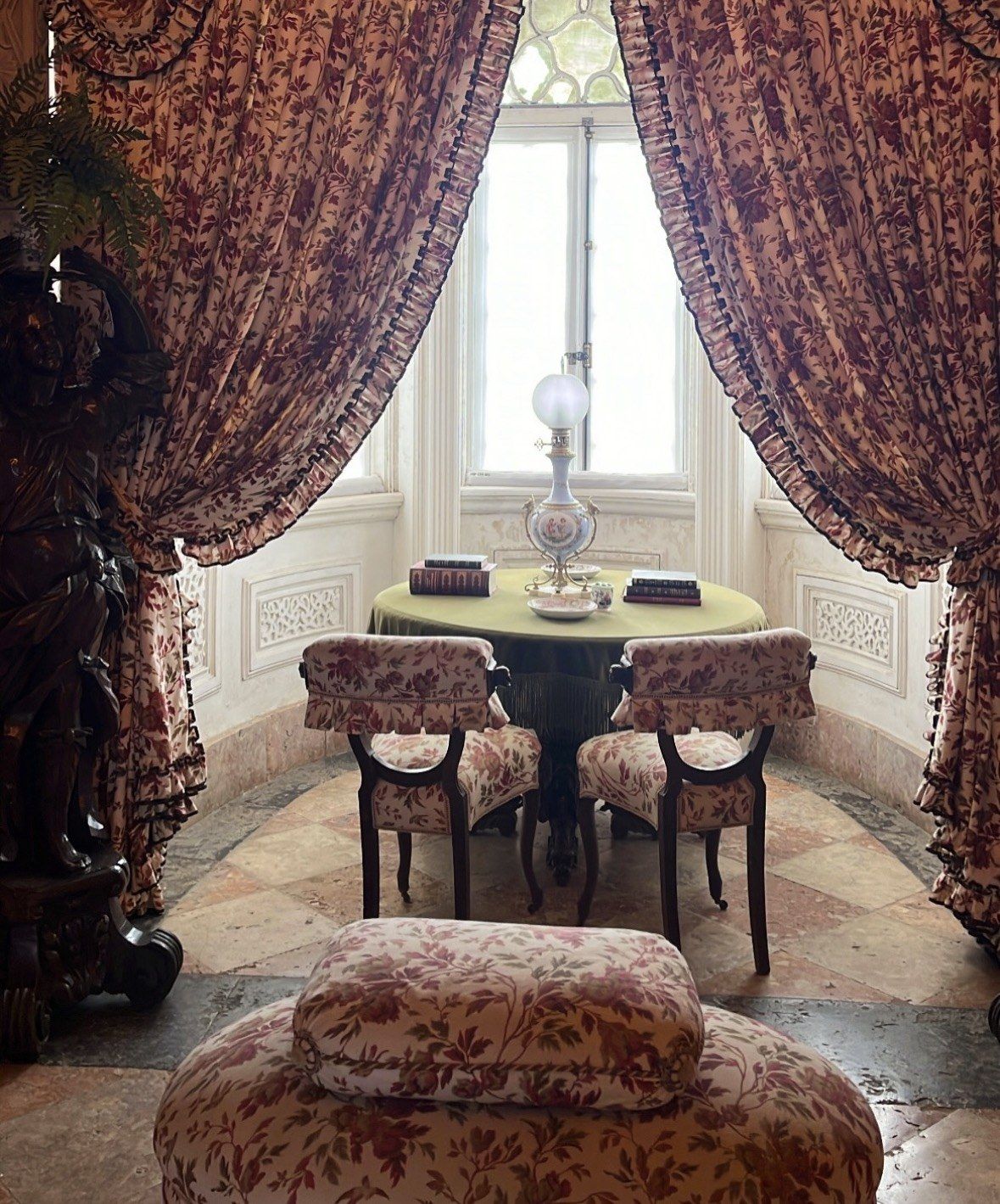
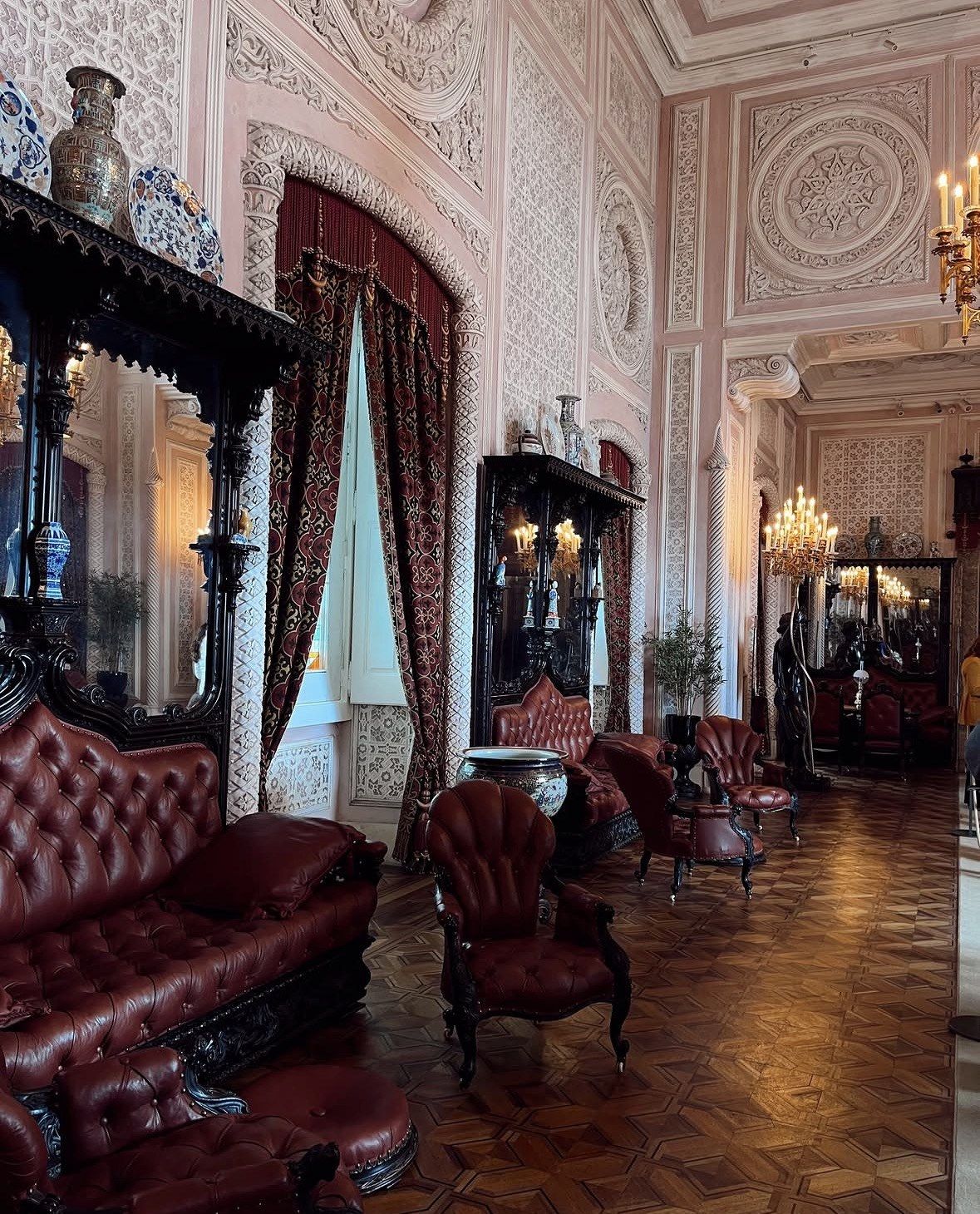
The Portuguese State bought the palace in 1889, and Carlos I and Queen Amelia used it as a summer residence from the 1890s, which is why the private apartments are furnished the way they are. The cloister entrance route stayed reserved for the Royal Family until 1910, the year Pena was classified a National Monument.
UNESCO inscribed the Cultural Landscape of Sintra as World Heritage in 1995, and Pena forms part of it. The site is run today by the state-owned company Parques de Sintra – Monte da Lua, which took over the park in 2000 and the palace in 2007 and now manages 11 parks and monuments in and around Sintra.
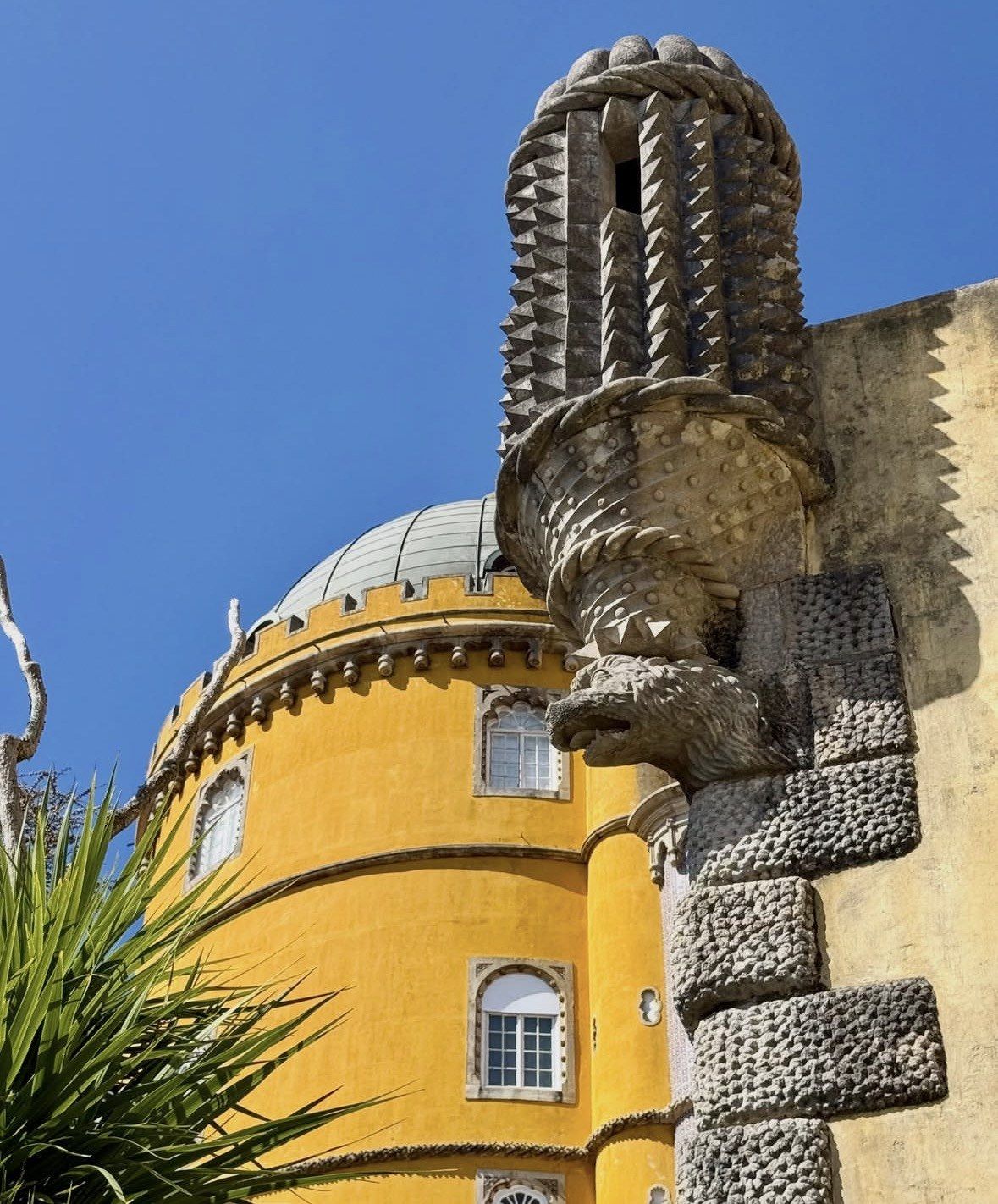
One recent date changes what you see more than any other. The 1994 restoration brought back the original colour scheme, old rose for the former monastery and ochre for the New Palace. The building had lost those colours completely, so most old photographs show it grey.
- Two wings joined: the Manueline monastery of the Order of Saint Jerome and the 19th-century wing of Ferdinand II
- Building work answered to Baron Wilhelm Ludwig von Eschwege, by profession a mineralogist and mine engineer
- The German references are Stolzenfels, Rheinstein and Babelsberg
- Hours to remember: the palace interior runs 09:30 to 18:30, the park 09:00 to 19:00, both with last admission at 18:00; closed 24 and 25 December, 31 December and 1 January
Hearing the story on the hill
The dates land differently when someone is pointing at the stonework. In the Manueline Cloister a guide can show you which arches are from 1511 and which staircase Ferdinand II added. Photography and video are not allowed inside the palace, so the interior is the one part of Pena you cannot look at on a screen beforehand.
Lisbon: Sintra Half-Day Guided Tour with Pena Palace Tickets fits the history into half a day: 5 hours, from €80, 4.9 ★ (624 reviews). An expert local guide stays with you throughout, the air-conditioned vehicle carries up to 8 people, insurance is covered, and the Pena Palace Essential Ticket for the palace interior and park entry is included, so the timed slot is settled before you arrive. The meeting point is next to the Hard Rock Cafe, and the price leaves out lunch and the Quinta da Regaleira ticket.
Eight hours at a pace you set is what Sintra Full Day Private Tour: Including Pena Palace + Regaleira offers, from €149 and rated 4.8 ★ (1803 reviews): a private driver/guide, pick-up and drop-off at your hotel, free Wi-Fi on board, and Pena Palace tickets in the price when the skip-the-line option is chosen. Lunch is not included. Take this one if you want time in the monastery half and on the Queen's Terrace without a group clock running.
If the 19th century interests you more than the 16th, Lisbon: Sintra Full Day Pena Palace, Regaleira & Monserrate covers 8 hours from €60 at 4.8 ★ (97 reviews), a small group in an air-conditioned van from central Lisbon, with expert-guided tours at Pena Palace and Monserrate Palace at additional cost and free time in Sintra for lunch, Quinta da Regaleira and the Initiation Well. Monument entrance fees, food and drinks are not included, the tour is in English only, departure is at 08:00 with Liberdade 9 as the reference and the guide in a yellow coat, and a 6-hour option exists. Free cancellation applies to all three up to 24 hours before the departure time.
Questions people ask
How old is the site Pena Palace stands on?
Several centuries older than the palace itself. A chapel occupied the hilltop from the 12th century, the Monastery of Our Lady of Pena was ordered in 1503, and the cloister you walk through dates from 1511. The 19th-century wing is the newest layer on ground that has held a chapel since the 12th century.
Why is Pena Palace pink and yellow?
A restoration in 1994 put the original scheme back: old rose on the former monastery and ochre on the New Palace. For a long stretch before that the building read as grey, which is why older pictures look like a different monument.
Can you still see the monastery inside the palace?
Yes, and for anyone who came for the history it is the best part of the route. The chapel was adapted from the Monastery Church of Our Lady of Pena, with Chanterenne's retable of 1529 to 1532 and the 1840 Nuremberg window facing the altar, and the Manueline Cloister of 1511 keeps its cuerda seca tiles. Cameras stay down once you are through the door, since image capture inside the palace is not permitted.
Which castles inspired Ferdinand II?
German Romanticism is the direct source, with Stolzenfels, Rheinstein and Babelsberg named among the influences. Baron Wilhelm Ludwig von Eschwege, who supervised the works, was a mineralogist and mining engineer with no architectural training, which is part of why the building reads as a set of quotations.
Who looks after Pena Palace today?
The state-owned company Parques de Sintra – Monte da Lua, which took over the park in 2000 and the palace in 2007 and manages 11 parks and monuments in and around Sintra. The State has owned the palace since 1889, and Pena has been a National Monument since 1910.
Read also