In shortInside Pena Palace the route runs from the 1511 Manueline cloister and the chapel, with its altarpiece carved by Nicolas de Chanterenne between 1529 and 1532, through the state and reception rooms of the New Palace, the royal apartments, the kitchen and out onto the terraces. The rooms keep their furniture and porcelain. Photography and video are not allowed indoors.
22 of 23points of interest indoors
1511Manueline cloister built
72 candlesGreat Hall chandelier
1529–1532chapel altarpiece carved
What you are walking into
The palace is two buildings joined together. The northern core is the former Royal Monastery of Our Lady of Pena, ordered by Manuel I in 1503 for the Order of Saint Jerome, and it holds the cloister and its dependencies, the chapel, a sacristy and a bell tower. Ferdinand II, who bought the ruin with his own funds in 1838 after the religious orders were dissolved in 1834, had the upper floor reworked so that 14 monks' cells became a smaller number of larger vaulted rooms. The wing beside it went up from about 1843 under Baron Wilhelm Ludwig von Eschwege, a mineralogist and mining engineer, and it holds the big rooms and the kitchens, with construction finishing in the mid-1860s.
The rooms are furnished. Carlos I and Queen Amelia used Pena as a summer residence from the 1890s, and the interiors are shown with the furniture, porcelain, lamps and hangings that belong to them, down to a room on the official list named for the final residents. Of the 23 named points of interest Parques de Sintra lists at Pena, 22 are palace rooms and terraces; only the Riding Ring sits out in the park.
The standard interior admission covers the New Palace, described on the official ticket page as the state and reception wing, along with the panoramic terraces. The kitchen and the chapel sit on that same self-guided palace and park route. If you are undecided, the page here on whether Pena is worth it sets the two halves side by side.
Interior ticket and a guide in the rooms
Five hours from €80 with the Pena Palace Essential Ticket for the palace interior and park entry included, so the timed slot is handled and someone is there to explain the Stag Room and the Great Hall while you stand in them.
★ 4.9/5 · 624 reviews
Inside Pena Palace: the cloister and the chapel first
The route opens in the old monastery. The Manueline Cloister dates from 1511, with galleries around a square patio, round arches on the lower floor and segmental arches above. Hispano-Mudejar tiles in the cuerda seca technique cover the patio walls, geometric rather than figurative, and the light dropping into that small square is the quietest moment of the whole interior. This was the monks' way in until 1834 and then the Royal Family's until 1910. Ferdinand II added the double staircase of parallel flights you climb here.
The chapel next door was adapted from the Monastery Church of Our Lady of Pena. Its main altar retable, in Sintra alabaster and limestone, was carved by Nicolas de Chanterenne between 1529 and 1532 for João III, and it is the oldest thing you will look at all day. Turn around before you leave: opposite the main altar is the stained-glass window Ferdinand II installed, made in 1840 by the Kellner family workshop in Nuremberg.
Both spaces are small and the group ahead of you tends to stall in them. Hold back a few metres rather than joining the crush at the altar rail; they move on within a minute or two.
Pena Palace rooms, from the Stag Room to the kitchen
The state and reception rooms come next. The Stag Room worked as the banquet hall and is hung with stag heads modelled in plaster and fitted with genuine antlers, a motif lifted straight from the Germanic romantic castles Ferdinand II had in mind, the same family of references as Stolzenfels, Rheinstein and Babelsberg. The Great Hall is the largest room in the palace and doubled as the Billiards Room: a gold-plated brass chandelier carrying 72 candles hangs over it, with four petroleum lamps alongside, Ferdinand II's Japanese and Chinese porcelain on the shelves above the sofas, and his Central European stained glass set into three of the windows. The Smoking Room sits in the same run.
Then comes the private side of the house, where the furnished-residence character is clearest. The official list names the Green Room, the Sitting Room, the Chambers of King Manuel II, the Chambers of King Carlos, the Bedroom of Ferdinand II, the Queen's Office, the Dressing Room of Queen Amelia with its Tea Room, and the Dining Room with its Pantry. These rooms are narrower than the halls and are often entered through a single doorway, which is where the line genuinely slows down.
The kitchen closes the indoor sequence, in the newer wing beside the circular tower. Copper, ranges and service equipment stay in place, and after the gilt and the porcelain it reads as the most practical room in the building.
| Part of the palace | Named rooms on the official list |
|---|
| Old monastery core | Manueline Cloister, Chapel, sacristy and bell tower, Courtyard of Arches |
|---|
| State and reception rooms | Stag Room, Great Hall (Billiards Room), Smoking Room |
|---|
| Royal apartments | Green Room, Sitting Room, Chambers of King Manuel II, Chambers of King Carlos, Bedroom of Ferdinand II, Room Ferdinand II, Queen's Office, Dressing Room of Queen Amelia with Tea Room, Room of the Final Residents |
|---|
| Service rooms | Dining Room and Pantry, Kitchen |
|---|
| Terraces and walkways | Triton's Terrace, Queen's Terrace with the Arabic Cabinet, Sentry Walk, Coach House's Terrace, Monumental Gate |
|---|
Stairways, the single direction of travel and the narrow stretches
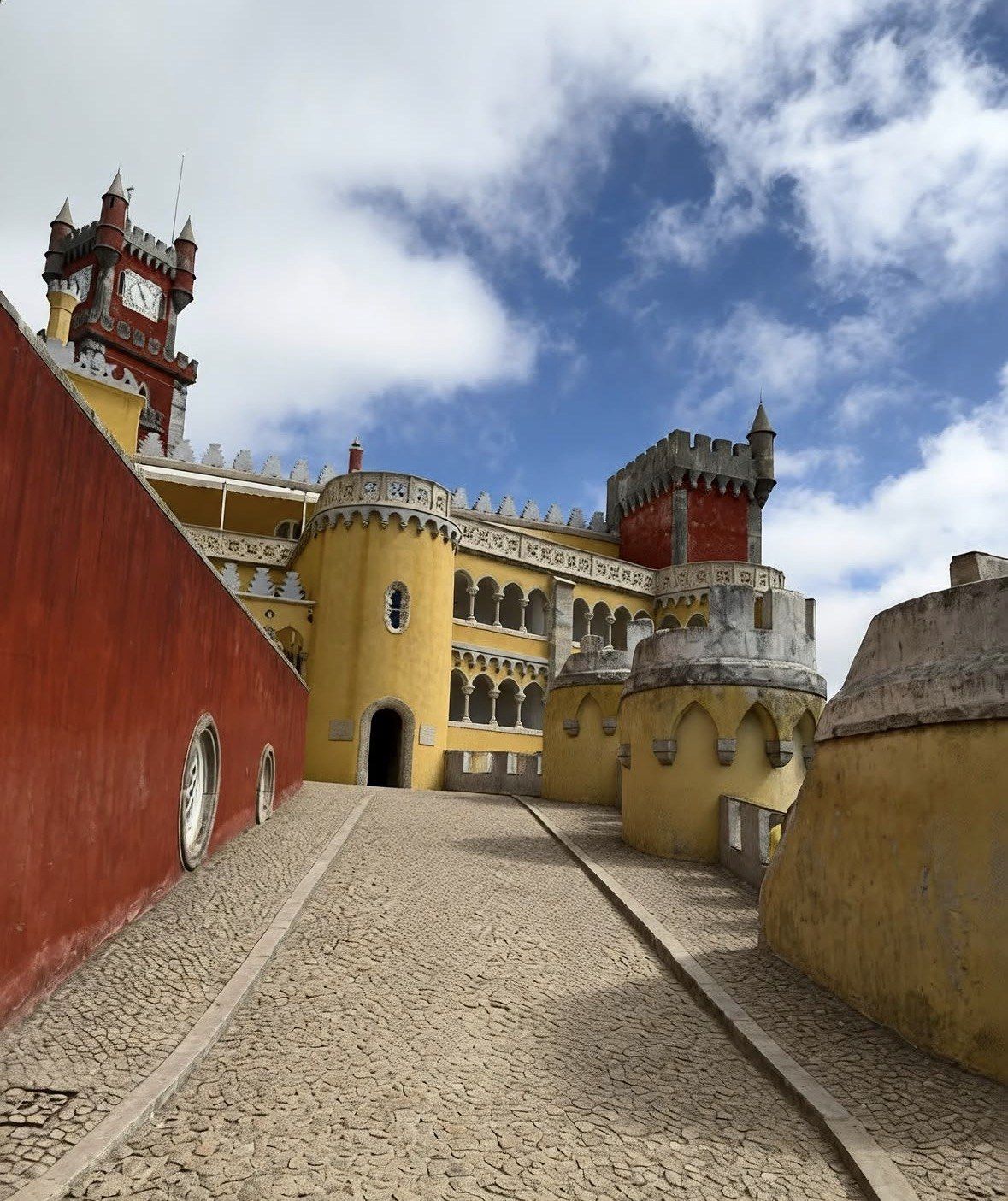
Circulation runs in one direction. You do not loop back for a room you hurried past, so if something is worth a second look, take it while you are standing there. The route also has stairways throughout, which is why Parques de Sintra states plainly that the palace interior is not accessible to visitors with reduced mobility. Even reaching the door takes effort: from the transfer stop there are about 90 metres of approach reaching gradients of up to 18%.
Interior entry runs on timed slots with a daily cap, which the operator describes as matching demand to what the building can take. The cap limits the day's total without spreading people evenly through it, and around 1.9 million went through the park and palace in 2025. The pressure indoors concentrates in the apartments and on the stairs between floors.
Book the first interior time of the day and you will have the cloister and the chapel close to empty. The route opens at 09:30, half an hour after the park gates, and the last admission is 18:00 with the doors closing at 18:30. Check the times on the day, since the official notices page occasionally changes them.
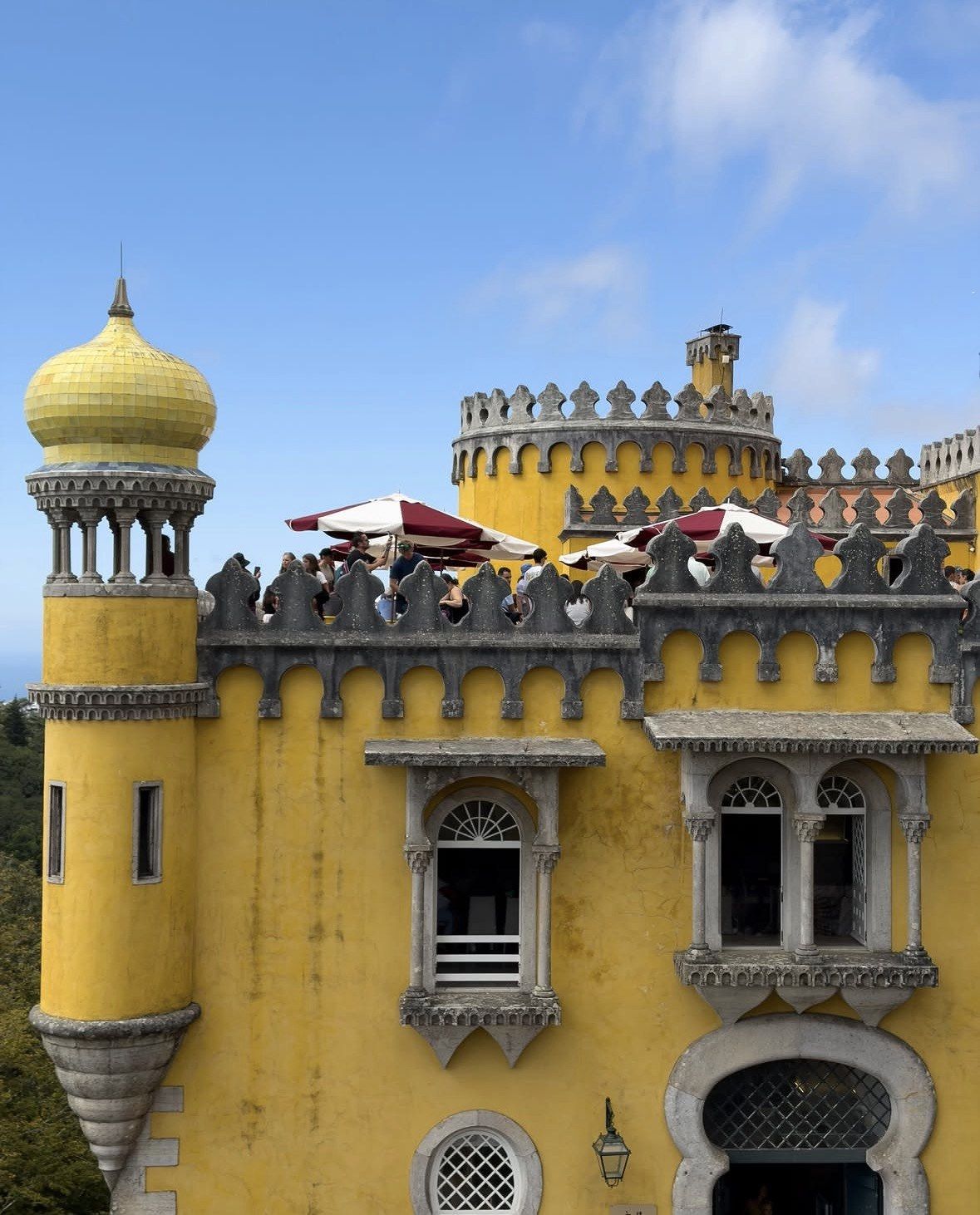
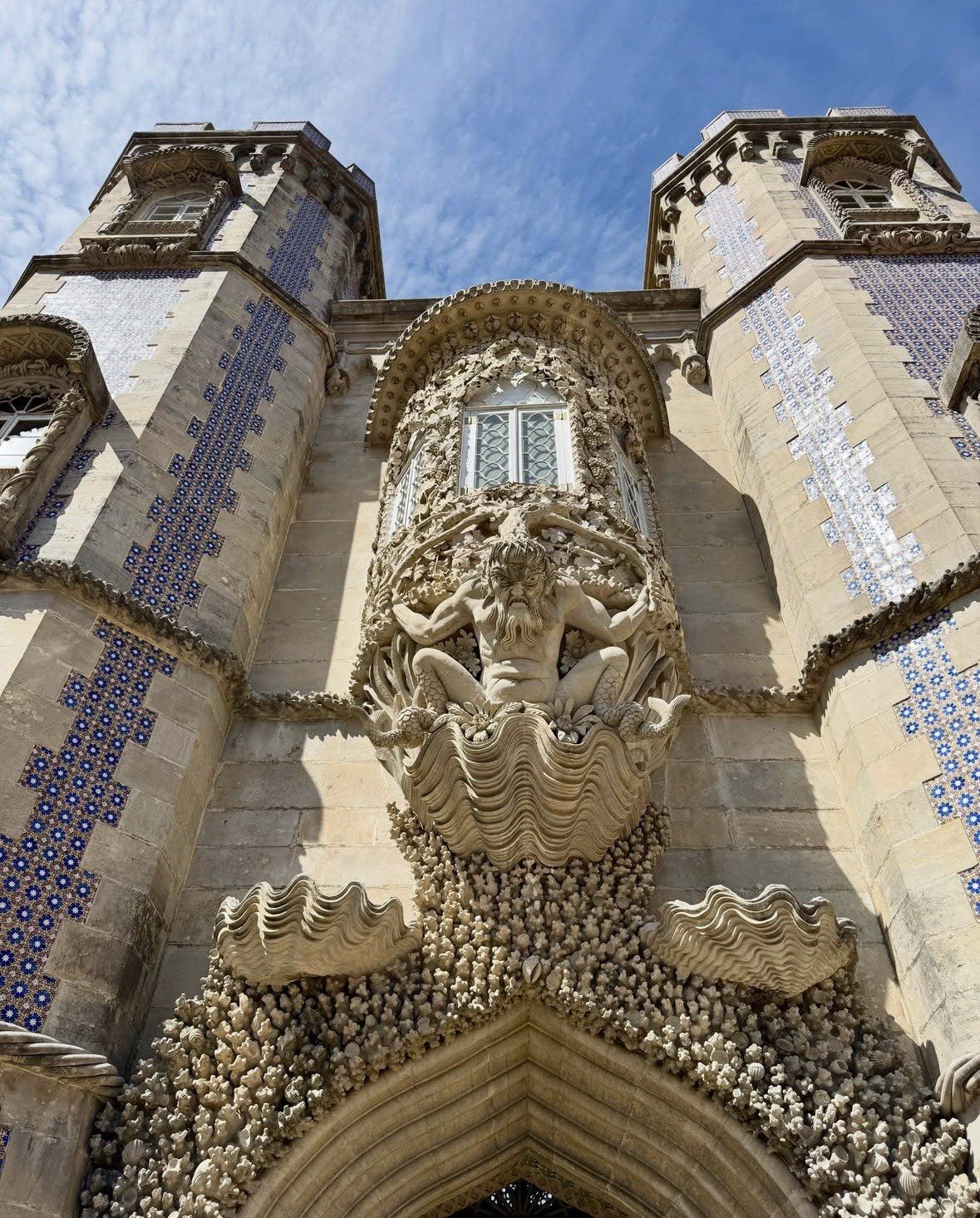
The terraces are the release valve. Triton's Terrace marks the entrance to the New Palace wing, with a Neogothic arch covered in coral motifs supporting three shells, a Triton seated on one of them, and a tree and vines climbing above a protruding window. At the back of the Queen's Terrace is a small room called the Arabic Cabinet, where a telescope was kept, with an awning stretched over the original metal structure in summer; look directly south from there and you are facing the High Cross, at 528 metres the highest point of the Sintra hills. For how all of this fits into a day, see the page here on how long to spend at Pena.
Photography and what is restricted
Taking photographs or video inside the National Palace of Pena is not allowed under the Parques de Sintra image-capture policy. People ask this constantly, and the answer does not change at the door: the camera stays down between the cloister and the exit onto the terraces. Capture for anything beyond general environments for private use, including commercial or public use, needs authorisation requested at least 15 working days in advance.
Leave the tripod at the hotel too. It is barred at every Parques de Sintra site, indoors and out, and the only way around that is written permission obtained beforehand, granted in exceptional cases. Flash and any other artificial light are not permitted in indoor spaces where capture is allowed, and drones or any remotely operated equipment are banned at Pena. A wedding photo or video session in the parks carries a heritage image utilization fee.
The terraces, the façades and the park are where the pictures come from, and that is where almost every Pena image you have seen was taken. Pets cannot be brought into Pena at all; properly identified assistance dogs are admitted.
- No photographs or video in the palace interior
- No tripods anywhere on site without prior written authorisation
- No flash or added light indoors where capture is permitted
- No drones or remotely operated equipment
- Properly identified assistance dogs admitted; no other pets
Getting commentary on the rooms
Nothing in the rooms explains itself. Labelling is minimal, and the difference between walking past a plaster stag head and understanding why a Portuguese king wanted a Rhineland hunting hall on a hilltop above Sintra is somebody talking you through it. The interior admission comes with the Zoomguide multimedia audio guide, which has artificial intelligence built in, plus the Pena Maps orientation tool and the Pena Quest game, all four available in Portuguese, English, Spanish and French. The audio guide page on this site covers what it does and where it falls short.
The alternative is a guide who is with you in the rooms and answers back. Three tours listed on this site take you inside, all of them cancellable free of charge up to 24 hours before departure. On Lisbon: Sintra Half-Day Guided Tour with Pena Palace Tickets, the interior is the reason for the trip: the Pena Palace Essential Ticket covering the palace rooms and park entry is already in the price, from €80 for 5 hours, with a local guide beside you the whole way, an air-conditioned vehicle holding up to 8 people, insurance and a rating of 4.9 ★ (624 reviews). Sintra Full Day Private Tour: Including Pena Palace + Regaleira gives the apartments as much time as you want to give them, over 8 hours from €149 at 4.8 ★ (1803 reviews); a driver/guide collects you at your hotel and brings you back, there is free Wi-Fi on board, and Pena tickets come with it when you pick the skip-the-line option. Lisbon: Sintra Full Day Pena Palace, Regaleira & Monserrate fills 8 hours from €60, rated 4.8 ★ (97 reviews), with a small group, round-trip transport from central Lisbon in an air-conditioned van and expert-guided tours at Pena Palace and Monserrate Palace at additional cost, leaving free time in Sintra for lunch and for Quinta da Regaleira.
For a first visit where the point is the interior, take the 5-hour guided half-day at €80: the interior ticket is part of it and a guide walks the rooms with you. With children or a group that will not move at one pace, the €149 private day bends to you. If you have seen Pena before and want Monserrate's interior as well, the €60 full day is the fit, with the guided visits there priced on top.
Questions people ask
Can I take photos inside Pena Palace?
No. The Parques de Sintra image-capture policy rules out both stills and video from the moment you step into the National Palace of Pena. The ban applies to the whole indoor route, from the Manueline Cloister through to the kitchen. Shoot on the terraces, along the façades and in the park instead, without flash, without a tripod and without a drone.
Are the rooms furnished or empty?
Furnished. The Great Hall still has its gold-plated brass chandelier with 72 candles, four petroleum lamps, Ferdinand II's Japanese and Chinese porcelain on the shelves above the sofas and his Central European stained glass in three windows. The Stag Room keeps its plaster stag heads fitted with real antlers, and the apartments, dining room and pantry are shown as rooms that were lived in.
Is the interior route doable with a wheelchair or a buggy?
Stairways run the full length of the visitor route, and on that basis the official accessibility page rules the palace interior out for visitors with reduced mobility. Even the approach is hard work: from the transfer stop the final stretch is about 90 metres, reaching gradients of up to 18%. The park, the terraces and the views are the realistic plan in that case.
Does the interior visit include the chapel and the kitchen?
Yes. The chapel, the kitchen and the terraces are all part of the self-guided palace and park offer, and the chapel is worth the pause for the Chanterenne altarpiece of 1529 to 1532 and the 1840 Nuremberg stained-glass window facing it. The cloister of the old monastery sits on the same route.
Which part of the interior gets busiest?
The narrow spaces: the cloister and chapel at the start, the royal apartments, and the stairs between floors. The big rooms absorb people better. Movement runs in one direction, so you cannot step aside and come back later; take the first slot of the day, at 09:30, if you want those stretches clear.
Read also