In shortPena Palace in Sintra has a colorful exterior because the building is two palaces painted differently: old rose for the former Monastery of Our Lady of Pena, ochre for Ferdinand II's 19th-century New Palace. The walls mix Neo-Gothic, Neo-Manueline, Neo-Moorish and Neo-Renaissance detail with merlons, watch-towers, tiled surfaces and the Triton arch. A 1994 restoration put the original tones back.
1503Monastery ordered by Manuel I
1838Ferdinand II buys the ruin
1843Clock tower finished
1994Original colours restored
Four revival styles stacked on one hilltop
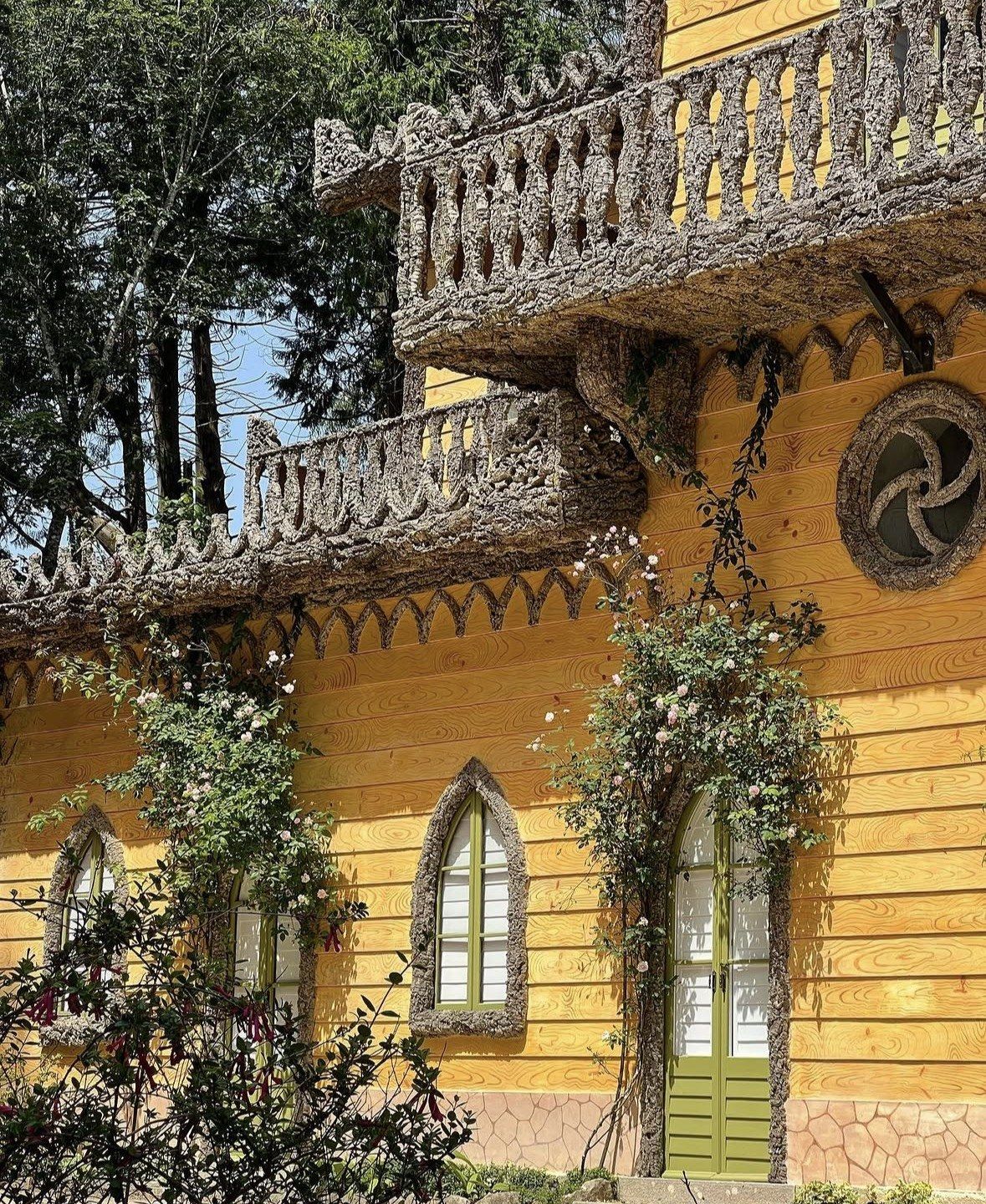
From below it looks like one building wearing several costumes at once. Neo-Gothic pinnacles and pointed arches run into Neo-Manueline carving borrowed from the Portuguese sixteenth century; Neo-Moorish horseshoe shapes and tilework sit next to Neo-Renaissance window frames. None of it pretends to be a single period, and that was the point. The patron bought himself that freedom: in 1838, four years after the dissolution of the religious orders, Ferdinand II used his own funds to acquire the roofless monastery and the land around it, so every surface was his to invent on. Parques de Sintra calls him the King-Artist. Day-to-day supervision of the building went to Baron Wilhelm Ludwig von Eschwege, who came to the job as a mineralogist and mining engineer rather than an architect.
The references came attached. The official account names the German Romantic castles of Stolzenfels, Rheinstein and Babelsberg, which is why the silhouette reads like a Rhine castle moved south and repainted. The setting counts too: 85 hectares of Romantic landscape around the walls, with the whole Cultural Landscape of Sintra inscribed by UNESCO as World Heritage in 1995. The chronology from the 12th-century chapel onwards sits on this site's history page.
The features visitors stop to photograph
Walk up from the park and the facades arrive in a fixed order. The outer ring first, then the gate, then the terraces. That enclosing third structure is stage scenery with a straight face: mock patrol paths, merlons, battlements and watch-towers, a tunnel running through to a drawbridge. The official list of points of interest calls those parts the Monumental Gate and the Sentry Walk, and they were built to be looked at from a distance.
The most photographed detail sits on Triton's Terrace, at the entrance to the New Palace wing. A Neogothic arch decorated with coral carries three shells, a Triton on one of them, and above a protruding window a tree and vines climb the stone. Stand under the arch and look up.
- Monumental Gate: the pointed entrance arch, the tunnel and the drawbridge access
- Triton's Terrace: coral-decorated Neogothic arch, three shells, the seated Triton, tree and vines over a protruding window
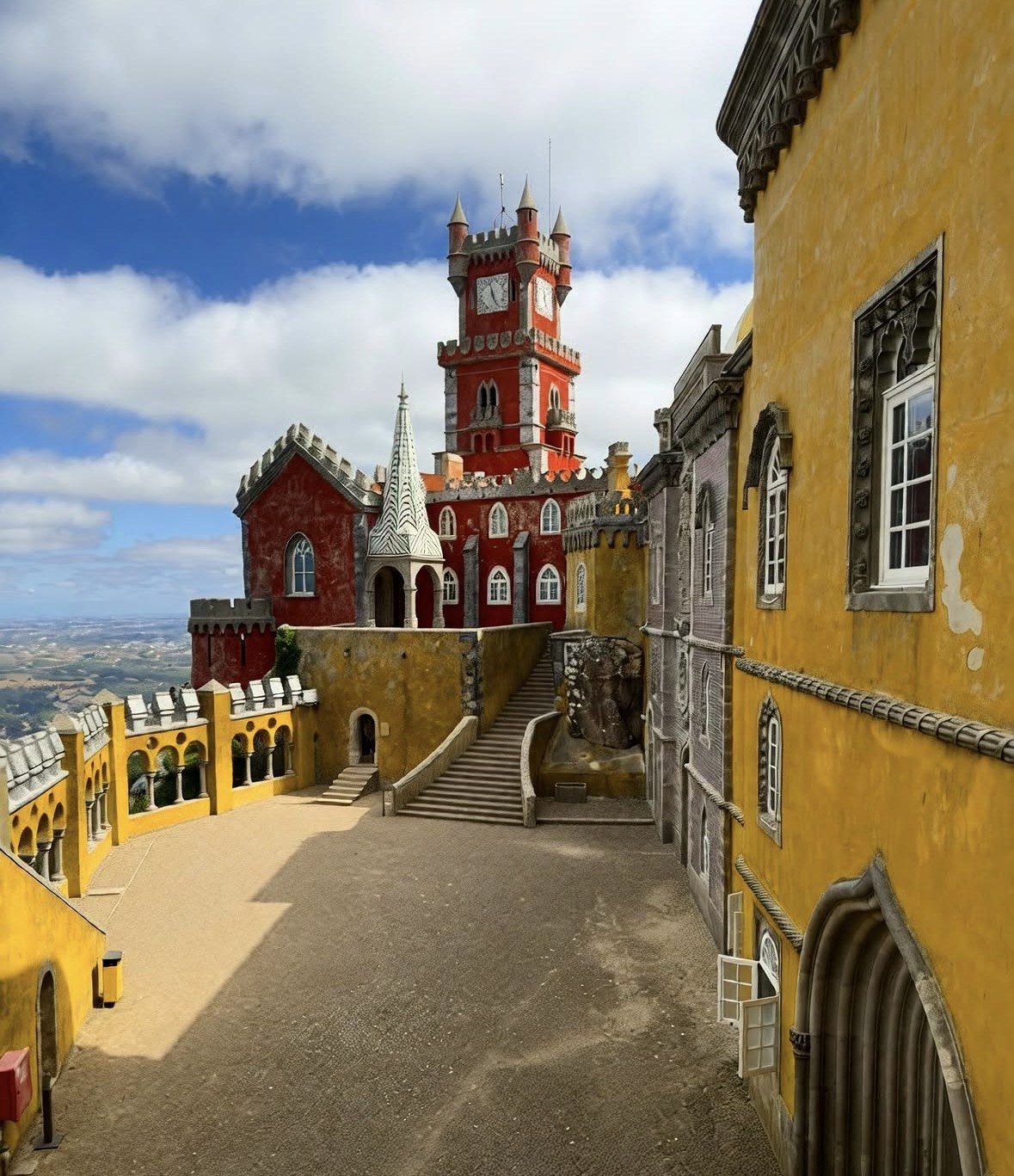
- Clock tower: finished in 1843, the vertical marker in almost every photograph of the yellow wing
- Round domed tower on the New Palace side, beside the new kitchens
- Manueline Cloister of 1511: galleries round a square patio, round arches below and segmental arches above, patio walls covered in Hispano-Mudejar tiles in the cuerda seca technique with geometric motifs
- Battlements, merlons and watch-towers on the encircling wall, with the Sentry Walk behind them
- Queen's Terrace: at the back of it a small room called the Arabic Cabinet, once the store for a telescope
Which parts are the monastery and which are Ferdinand's
The northern core is the surviving monastery: cloisters and their dependencies, a chapel, a sacristy, a bell tower, all of it descended from the Royal Monastery of Our Lady of Pena that Manuel I ordered in 1503 for the Order of Saint Jerome. Ferdinand II worked over that fabric as well. On the upper floor he replaced 14 monks' cells with fewer, larger vaulted rooms, and he put a double staircase of parallel flights at the cloister entrance, the clearest 19th-century intrusion on the old side.
Everything theatrical is his. The New Palace wing rose from 1843 under the Baron of Eschwege, holds the larger rooms including the Main Hall, and ends in the circular tower next to the new kitchens, with work running on into the mid-1860s. The Portuguese State bought the palace in 1889; the classification as National Monument came in 1910.
| Element of the facade | Monastery or Ferdinand II | Date |
|---|
| Chapel, reworked from the old Monastery Church of Our Lady of Pena | Monastery | Monastery ordered 1503; main altar retable carved by Nicolas de Chanterenne 1529-1532 |
|---|
| Manueline Cloister and its tiled patio | Monastery | 1511 |
|---|
| Bell tower and sacristy in the northern core | Monastery | From the 1503 foundation |
|---|
| Larger vaulted rooms over the cloister, replacing 14 monks' cells | Ferdinand II | After 1838 |
|---|
| New Palace wing, Main Hall, circular tower and new kitchens | Ferdinand II | From 1843, ending in the mid-1860s |
|---|
| Clock tower | Ferdinand II | 1843 |
|---|
| Encircling wall with mock patrol paths, merlons, battlements, watch-towers, tunnel and drawbridge | Ferdinand II | 19th century |
|---|
| Stained-glass window facing the chapel altar, Kellner family workshop, Nuremberg | Ferdinand II | 1840 |
|---|
Walls and rooms in five hours
A local guide stays with you the whole way and the Pena Palace Essential Ticket for the palace interior and park entry is already in the price, so the red wing, the yellow wing and the timed entry are all covered inside one 5-hour block.
★ 4.9/5 · 624 reviews
Why Pena Palace is red and yellow
The two colours track the two buildings. Ferdinand II's scheme gave the former monastery a red tone and the New Palace a yellow one, so the paint tells you where the 16th-century core stops and the 19th-century wing begins before you read a single label. The official description calls the shades old rose and ochre, which is closer to the walls in morning light than the reds you see on postcards. Stand on the terrace between the two and the join is obvious.
For most of the twentieth century none of that was visible. The colours faded, the palace stood in plain grey, and a generation of visitors knew only the grey version you find in older photographs and prints. The repainting carried out in 1994 brought the scheme back, and the pairing you photograph now dates from that work: old rose across the former monastery, ochre across the New Palace.
The grey stone still showing is structural trim: window surrounds, arches, the carved Manueline detail. It was cut to read against colour, so on the yellow wing the frames stand out and on the rose wing they settle back.
Where to stand for the facades, and when
Photography and video are not allowed inside the National Palace of Pena, so the facades are the part of the day you can take home. Count on hand-held shots: tripods need prior written authorisation and are otherwise forbidden at every Parques de Sintra site, drones and other remotely operated equipment are banned, and in the indoor spaces where capture is allowed at all, flash and artificial light are not.
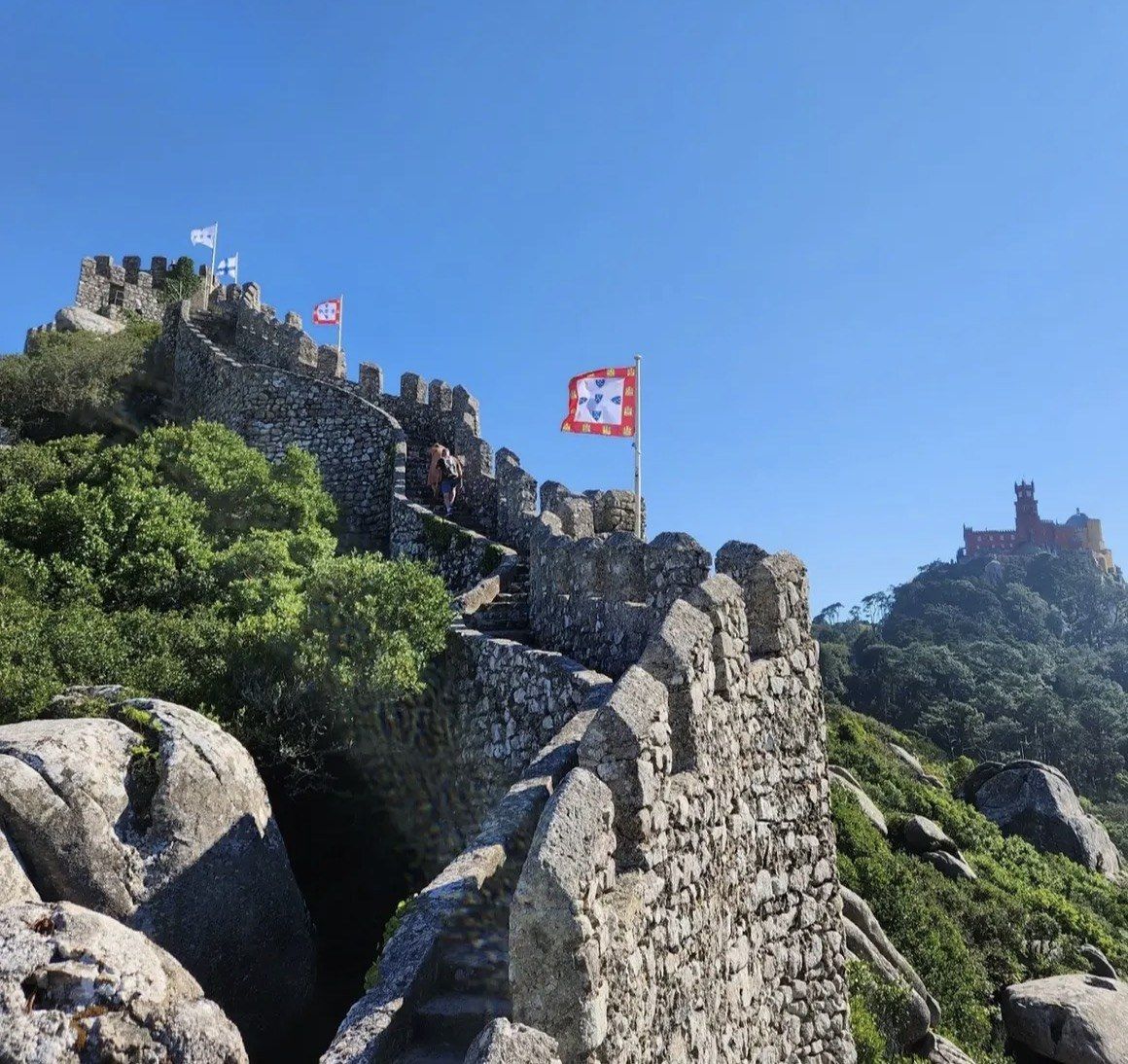
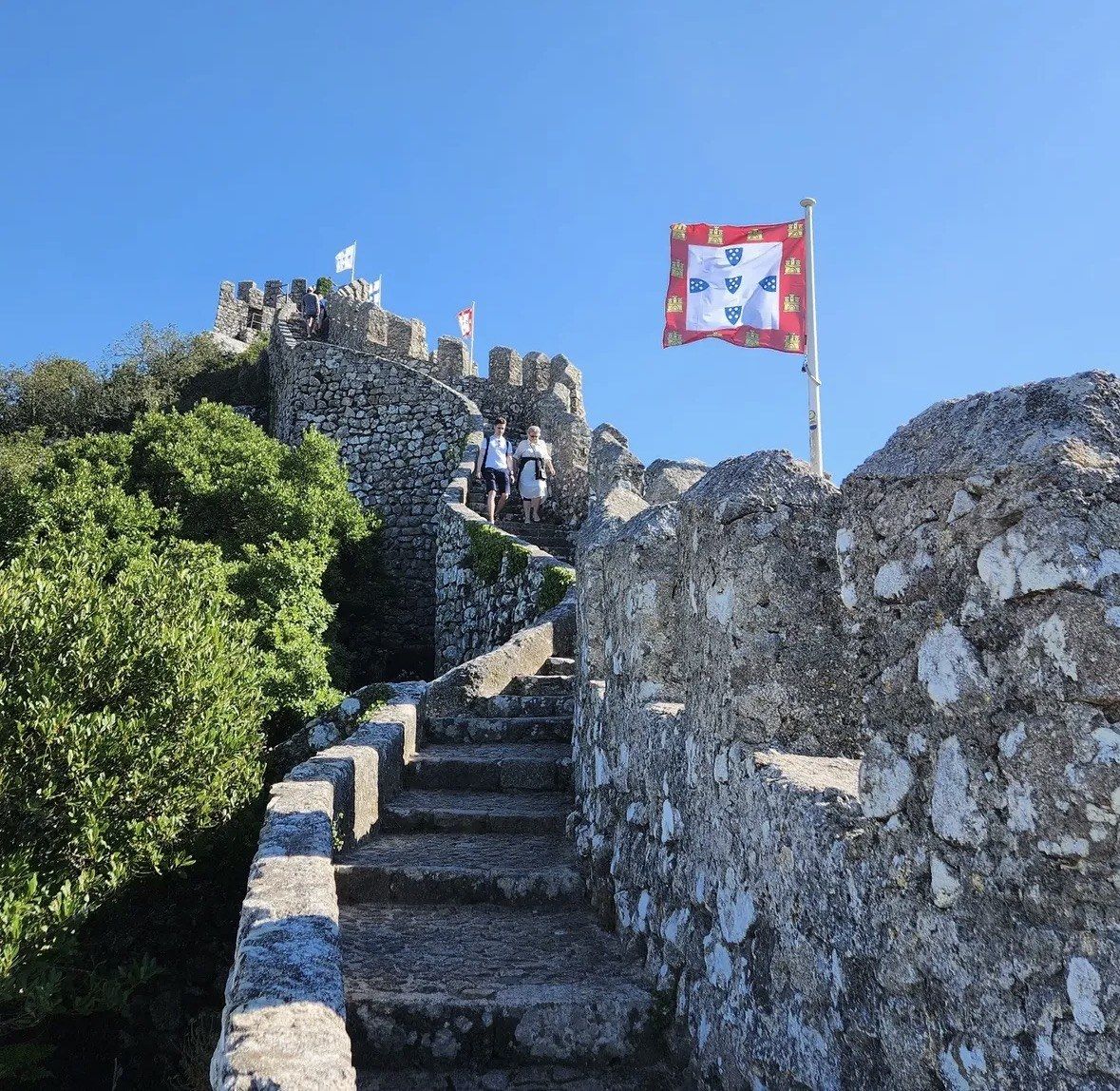
The hill runs on two clocks. The grounds are yours from 09:00 to 19:00, with the last ticket and the last admission both at 18:00, and that is the window for the exterior; the interior keeps a shorter day, 09:30 to 18:30, last ticket at 17:30 and last admission at 18:00. Check both the day before, because notices on the hill change. For the facades, start on the Queen's Terrace: from there you look due south to the High Cross, the highest point of the Sintra hills at 528 metres, with Lisbon, Cascais and the Atlantic beyond. The other view is from outside the walls. The parapet walk at the Moorish Castle looks straight back at Pena, and that is where the old rose and the ochre read best, with both wings in one frame.
Low cloud blows in off the Atlantic and sits on this ridge. When it does, the long views go and the old rose and ochre get deeper. The viewpoints page on this site lists the standing points; the interior page covers what happens past the door.
Tours that explain the walls while you are standing in front of them
A guide earns the fee here. Almost nothing on the facades is self-explanatory, and the signage outdoors is sparse. Three of the tours listed here put a guide in front of the walls, each on a different arrangement.
Small Group Tour to Sintra, Pena Palace, Cabo Roca and Cascais: 8 hours, from €70, 4.9 ★ (5026 reviews), an air-conditioned mini-van capped at 8 passengers, with pick-up and drop-off at hotels in the city centre. The guided tour happens at the outside of the monuments, which is exactly the subject of this page. Admission to Pena sits outside that price, with the guide carrying the tickets and you paying the guide. Lunch is not included either.
Lisbon: Sintra Half-Day Guided Tour with Pena Palace Tickets compresses things into 5 hours from €80, 4.9 ★ (624 reviews): an expert local guide with you throughout, an air-conditioned vehicle for up to 8 people, and the Pena Palace Essential Ticket covering the palace interior and park entry already in the price, so the timed entry is dealt with before you reach the gate. You meet next to the Hard Rock Cafe, and lunch is your own. The private option, Sintra Full Day Private Tour: Including Pena Palace + Regaleira, runs 8 hours from €149 at 4.8 ★ (1803 reviews), with a driver/guide to yourselves, hotel pick-up and drop-off, free Wi-Fi, and Pena Palace tickets covered when the skip-the-line option is chosen. All three can be cancelled free of charge up to 24 hours before departure, which is worth having on a ridge where wind can close the park to circulation.
The decision comes down to where you want the guide talking. For the facades, the terraces and the park, take the €70 small group, because its guiding happens outdoors where the architecture is. For the rooms as well as the walls, with the timed slot already handled, the 5-hour half-day at €80 is cleaner. Families and mixed walking speeds should take the €149 private day and use the extra hours standing still.
Questions people ask
Can I use a tripod or a drone to photograph the exterior?
No to both. Tripods are forbidden across Parques de Sintra sites except in exceptional cases with prior written authorisation, and drones or any remotely operated equipment are not allowed at Pena. Anything beyond general views taken for private use, commercial and public purposes included, has to be cleared first, with the request submitted at least 15 working days ahead.
Which castles was Ferdinand II copying?
The official account points to German Romantic models: Stolzenfels, Rheinstein and Babelsberg. The works at Pena were supervised by Baron Wilhelm Ludwig von Eschwege, a mineralogist and mining engineer rather than an architect, which helps explain a building assembled from quotations instead of designed in one style.
Is the chapel part of the original monastery?
Yes. What serves as the palace chapel is the old Monastery Church of Our Lady of Pena, adapted; its main altar retable, in Sintra alabaster and limestone, was carved by Nicolas de Chanterenne between 1529 and 1532 for João III. Facing the altar, Ferdinand II placed a stained-glass window of 1840 made by the Kellner family workshop in Nuremberg.
When did Pena become a protected monument?
The Portuguese State bought the palace in 1889 and Pena was classified a National Monument in 1910. The Cultural Landscape of Sintra, which includes the palace and its park, was inscribed by UNESCO as World Heritage in 1995. Management arrived later and in two steps: the park passed to Parques de Sintra in 2000, the palace in 2007.
What happens to the facades on a windy day?
Strong wind can shut the park to circulation, leaving the transfer bus as the only way up to the palace, so the walk-up views of the walls go and the terraces become the visit. Check the operator's notices the day before. Free cancellation applies to the tours listed here up to 24 hours before departure.
Read also